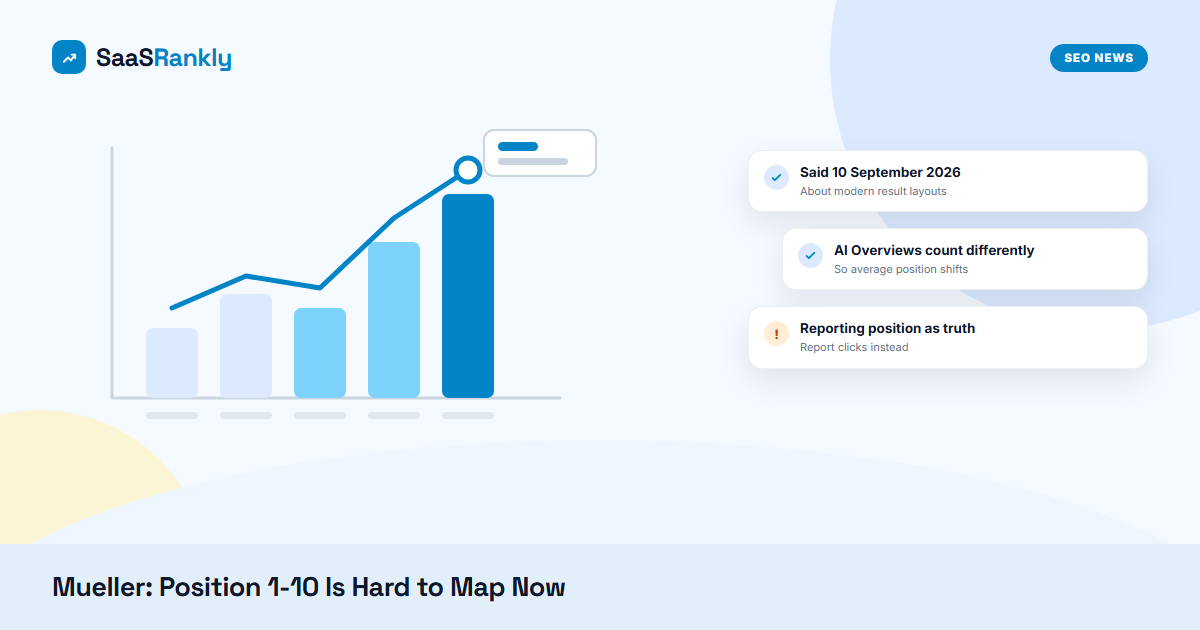
What happened: On September 10, 2026, Google’s John Mueller answered a Reddit question about how Search Console counts impressions for generative AI results, and in the process said out loud what a lot of SaaS teams already suspected about average position. “Search results pages have a lot of ways for users to interact nowadays, so the old ‘position 1 – 10’ is hard to map, or to make useful for site owners,” he wrote. He added that Google looks at generative AI performance as a block for now, and asked what kind of position data would actually help site owners.
Source(s): Search Engine Roundtable, September 10, 2026, the original r/SEO thread, and Google’s own help pages on how impressions and position are counted and the generative AI performance report.
Update (September 14, 2026): Search Engine Journal’s Roger Montti took a closer look at Mueller’s full reply, and two details matter for anyone reading average position and impression data. Mueller also wrote that position “is hard to do in a way that makes it useful, so we’re currently tracking it like we do for many search features (as a block)” and that it is “not separated out in the Gen-AI performance report.” SEJ’s reading of the standard impression rule is that a link cited in an AI Overview counts as an impression when the results page is served, whether or not the searcher scrolled to it, while links sitting behind “Show more” do not count until someone expands the overview. In practice, AI Overview impressions can run high for citations nobody saw and low for citations that only appear in the expanded part. Google has not announced any change to the report, and there is no new statement beyond the September 10 thread.
Why average position means less for SaaS sites now
Average position in Search Console was always a blended number. It averages your top ranking across every query where you appeared, so one page can show 4.2 while being first for one term and fortieth for another. On a ten blue links SERP you could live with that, because the number roughly matched what you saw when you searched.
That match is gone. A query like “best onboarding software” can now return an AI Overview, a People Also Ask block where 97 percent of answers are AI generated (see our PAA data post from yesterday), a video carousel, a Reddit block and only then the organic results. Your page might be cited in the AI Overview and also rank as the fifth blue link. Both get logged, and neither tells you whether a buyer saw your brand or clicked.
For SaaS teams the pain shows up in reporting. Leadership dashboards still chart average position, and a move from 6.1 to 4.8 gets read as progress even when the page now sits under a long AI Overview and clicks dropped.
How Search Console counts average position in AI features
Google’s documentation spells out the rules. Know them before you trust any trend line.
| Feature | Impressions | Position rule | Generative AI report |
|---|---|---|---|
| AI Overviews | Standard impression rules | The whole AI Overview takes one position and every link inside it gets that same position | Impressions only, no clicks or position |
| AI Mode | Standard impression rules | Same method as a normal results page; carousels and image blocks use their usual position rules | Impressions only, no clicks or position |
| Classic organic results | Counted when your result is shown | Topmost position of your site for that query | Not included (main Performance report) |
Two things follow. A citation listed sixth in a long AI Overview source panel gets the same average position as the first citation. And the generative AI performance report, which Google introduced in June and which reached all sites worldwide by August 31, shows impressions by page, country, device and date with no click or position data at all. The one report built for AI search skips position data on purpose, and Mueller’s comment explains why.
What Mueller’s comment does not mean
It does not mean Google is removing average position from Search Console. Nothing in the thread suggests that. It means Google knows the metric maps poorly onto AI features and has not settled on a better one yet. His request for feedback is a real opening, so if your team has a view on what position data would help, the Reddit thread is where he asked.
What to do
- Demote average position on your dashboard. Keep it as a diagnostic, not a headline KPI. Lead with clicks, CTR by query segment and organic signups. If you need a layout, start from our SaaS SEO reporting dashboard guide.
- Split average position by SERP type. Export your queries from Search Console, tag the ones that trigger an AI Overview (most rank trackers can flag this) and compare position and CTR for the two groups separately. Our guide on measuring SaaS SEO in GA4 and GSC walks through the segment setup.
- Report generative AI impressions as their own line. Track AI Overview and AI Mode impressions per money page month over month. It will not give you a position, but it tells you whether you are being cited at all, which is the question leadership is really asking.
- Check what your rank tracker is measuring. Many tools report an organic only or pixel based position that will never match Search Console. After the google.com/goto redirect problem broke several trackers last month, confirm how yours handles AI Overview citations. Our rank tracker comparison is a good starting point if you need to switch.
Update (September 18, 2026): Mueller came back to the same subject on LinkedIn, and Search Engine Roundtable picked it up on September 16. His line was that this reporting will “evolve over time” because Search, AI Mode and AI Overviews “evolve too”, that “there are edge-cases” in how positions get counted, and that the aim is not “a written-in-stone absolute truth for position counting (that’s impossible), but rather to make something that’s useful for site owners”. Google will “update the documentation when / if there are significant changes”. So do not build a board report that depends on today’s average position rules holding still: keep the definition you used written next to the number, and re-read the Search Console docs before each quarterly review. Source: Search Engine Roundtable, September 16, 2026.
Quick recap: average position
- Mueller said on September 10, 2026 that the old position 1-10 is hard to map to modern results, which puts Search Console average position in doubt for AI heavy SERPs.
- In AI Overviews, every cited link gets the same position, no matter which slot it sits in.
- AI Mode average position follows standard results page rules, with carousels and image blocks counted under their own rules.
- The generative AI performance report shows impressions only, with no clicks and no average position.
- Treat average position as a diagnostic and lead SaaS reporting with clicks, CTR by segment and organic signups.
- Split average position by queries with and without an AI Overview before you read any trend.
- Per SEJ’s September 13 follow-up, AI Overview citations count as impressions when the page is served, but links behind Show more only count once expanded, so read average position and impressions together.
- Mueller added on September 16, 2026 that average position rules will keep changing as AI Mode and AI Overviews change, so document the definition behind every average position number you report.