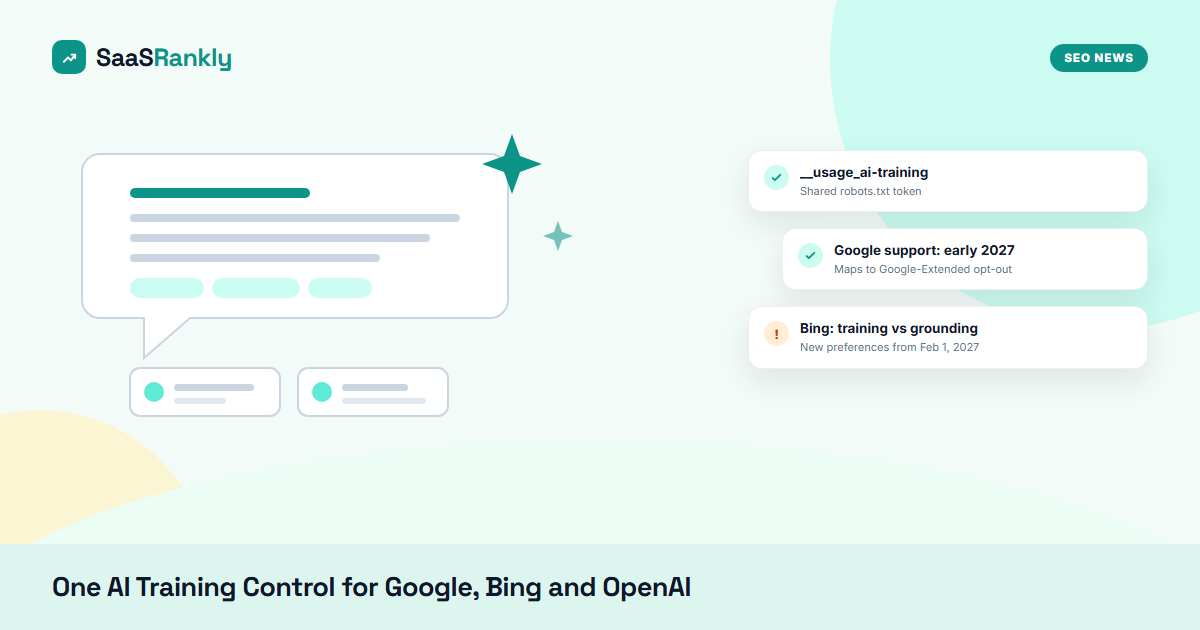
What happened: On October 30, 2026, Google said it will voluntarily adopt a shared AI training control for websites, based on an IETF draft called draft-kelley-aipref-training-preference-signal. The idea is simple: one robots.txt rule, using the policy token __usage_ai-training, tells every participating AI provider whether your content can be used to train models. Microsoft Bing announced its own new training and grounding preferences the same day, and OpenAI and Anthropic have said they plan to honor the shared signal too. Google says the AI training control “will help websites express their AI training preferences across multiple AI providers in a single step,” and it intends to support it in early 2027.
Sources: Google Search Central blog, Google crawling changelog (October 30 entry), Bing Search blog, IETF draft, and reporting by Search Engine Roundtable.
For SaaS teams this is the first time the big AI companies have agreed on anything close to a common switch for training. Until now, if you wanted to keep your docs, blog and help center out of model training, you had to list GPTBot, Google-Extended, ClaudeBot, CCBot and a handful of others one by one, and hope you didn’t miss a new crawler. Below is what changed, what did not, and what we would do on a SaaS site this week.
AI training control: the timeline so far
The news landed in a single afternoon, but the work behind it has been running for most of the year. Here is the sequence as it stands on November 2, 2026.
| Date | What happened |
|---|---|
| Early 2026 | The IETF AI Preferences (AIPREF) working group starts building a shared vocabulary for how AI systems may use web content. |
| October 30, 2026 | Google publishes “Supporting a shared AI training control for websites” and adds a note to its common crawlers page about future support. |
| October 30, 2026 | Microsoft Bing announces separate AI training and AI grounding preferences, plus a “limited grounding” option. |
| October 30, 2026 | OpenAI says it will honor the shared signal and share implementation details in the coming months. Anthropic signals support on the IETF mailing list. |
| December 15, 2026 | Bing opens temporary grounding preferences in Bing Webmaster Tools for sites that currently use NoArchive or NoCache. |
| Early 2027 | Google intends to start honoring the shared AI training control. |
| February 1, 2027 | Bing starts honoring the new preferences as it crawls pages. |
| March 1, 2027 | Bing stops reading NoArchive and NoCache as AI preferences. |
| September 30, 2027 | Bing’s temporary grounding preferences expire. |
So nothing breaks today. You have a few months to decide, and that is the right way to treat it: a policy decision first, then a five-minute robots.txt edit.
What changed technically
A shared policy token in robots.txt
The proposal reuses robots.txt rather than inventing a new file. Instead of a real crawler name, you write a “usage” token in the user-agent line. Bing published the clearest example:
User-Agent: __usage_ai-training
Disallow: /
That rule says: do not use anything on this site for AI training. You can also scope it to a folder, for example Disallow: /docs/, if you only want to protect part of the site. The token is not a bot. No crawler identifies itself as __usage_ai-training. Each participating company reads the rule and applies it to its own training pipeline.
How it maps to Google-Extended
Google’s line is the most important detail for most sites. If you opt out with the shared token and do not mention Google-Extended at all, Google plans to treat that as if you had disallowed Google-Extended. John Mueller put it plainly: “Google plans to interpret that as if the publisher had disallowed Google-Extended.”
Company-specific rules keep working. If you add an explicit User-agent: Google-Extended group, that wins for Google. Sites that specifically allow Google-Extended stay eligible to appear in Gemini Apps answers through grounding. This gives you a broad default plus per-provider exceptions, which is how most of us already think about bots.
Bing splits training from grounding
Microsoft went further. It now separates three choices:
- AI training: can your content be used to train models.
- AI grounding: can your content be used to generate AI answers, for example in Copilot.
- Limited grounding: your content can support Microsoft’s own AI products, but not its third-party grounding services.
Page-level controls use a meta tag or an HTTP header:
<meta name="Bingbot" content="ai-training:disallow">
<meta name="Bingbot" content="ai-grounding:disallow">
<meta name="Bingbot" content="ai-grounding:disallowextended">

X-Robots-Tag: Bingbot: ai-training:disallow
Bing is clear that classic rankings do not move with any of this. In its own words, “Publishers should not have to choose between being discoverable in Bing and deciding how generative models use their work.” Blocking grounding, though, does pull your pages out of AI answers, and that is a real visibility cost.
What the AI training control does not cover
This is where people will get confused, so it is worth being blunt:
- It is about training, not search. Google’s announcement does not say the token changes how AI Overviews or AI Mode use your pages. Those features run off Googlebot and normal Search indexing, and Google-Extended has never removed a site from Google Search.
- It is not a final standard yet. The token comes from an individual Internet-Draft. Nate Hake, who takes part in the IETF work, said it is “not actually done at the ietf level” and that significant areas of dispute remain, including an exemption for user-initiated actions.
- It only binds companies that adopt it. Smaller scrapers that ignore robots.txt today will keep ignoring it.
Who is affected
In practice, every site that publishes text. But the impact differs a lot by type of SaaS business:
- Content-led SaaS (big blogs, templates, glossaries): your content is your moat, and training use gives you nothing back. This group has the strongest case for opting out of training while keeping grounding open.
- Developer tools and API products: you probably want models to know your SDK syntax, because developers ask ChatGPT and Claude how to use your API. Blocking training on /docs/ could mean models write outdated code for your product. Many dev-tool companies will choose to allow training on docs.
- Early-stage SaaS with low brand awareness: being in training data is one way a model learns your brand exists. Opting out costs you more than it costs a household name.
- SaaS with gated or customer data in public help centers: review what is actually public. The AI training control helps, but the real fix for sensitive content is not to expose it publicly at all.
- Agencies running many client sites: one token instead of eight bot groups makes policy rollouts much easier across a portfolio.
What the AI training control means for SaaS sites
The bigger story is the split between training and grounding. For a SaaS marketer these are very different trades.
Training is long-term and invisible. Your page goes into a dataset, the model learns patterns from it, and you never see a citation or a click. Grounding is short-term and measurable. When ChatGPT, Copilot or Gemini fetches your page to answer a live question, there is a chance of a citation, a link and a visit. Most of the AI search visibility work we cover in our guide on getting SaaS pages into Google AI Overviews depends on grounding and retrieval, not training.
That means a sensible default for many SaaS sites will be: block training on content you want to protect, allow grounding everywhere you want to be cited. Before this week, that policy was messy to express. With the shared AI training control plus Bing’s grounding options, it becomes possible to write down cleanly.
There is also a measurement angle. Search Engine Roundtable reported on October 30 that a study found AI Overviews and AI Mode click-through rates around 0.9%, and that Gemini stopped attaching UTM parameters to cited URLs. Clicks from AI answers are small and getting harder to track. If you decide to keep grounding open, do it because citations build brand recall, not because you expect a traffic spike.
What to do now: 7 steps
- Audit your current robots.txt. List every AI-related group you already have: GPTBot, OAI-SearchBot, ChatGPT-User, Google-Extended, ClaudeBot, PerplexityBot, CCBot, Applebot-Extended. Note which are allowed and which are blocked. Check that nothing important is blocked by accident; our post on fixing “Blocked by robots.txt” in Search Console covers the common mistakes.
- Write a one-line policy per section of the site. For example: blog = no training, grounding allowed; docs = training allowed, grounding allowed; pricing and comparison pages = everything allowed. Get sign-off from whoever owns content and legal. This is the step most teams skip.
- Do not remove search bots. Keep Googlebot, Bingbot and OAI-SearchBot allowed on public pages. Blocking the wrong bot is how SaaS sites quietly lose AI Overviews and ChatGPT citations. The AI training control is not a reason to touch search crawlers.
- Prepare the shared token, but decide on timing. Adding a
User-Agent: __usage_ai-traininggroup now is harmless for regular crawling, since no real crawler uses that name. Google will not honor it until early 2027 and Bing from February 1, 2027. If you add it now, test the file in Search Console’s robots.txt report and keep a comment explaining what it does. - Keep explicit Google-Extended rules if you want Gemini grounding. If you opt out of training with the shared token but still want Gemini Apps to cite you, add an explicit
User-agent: Google-Extendedgroup withAllow: /. Without it, Google will read your shared opt-out as a Google-Extended disallow. - Handle Bing before March 1, 2027. If you rely on NoArchive or NoCache today to keep content out of Bing’s AI features, those stop counting as AI preferences on March 1, 2027. Add the new
ai-trainingandai-groundingmeta tags or headers, and use the temporary grounding preference in Bing Webmaster Tools from December 15 if you need time. - Measure before and after. Record a baseline now: AI citations in Bing Webmaster Tools’ AI Performance report, AI referral sessions in GA4, and brand mentions in ChatGPT and Perplexity for your top 20 queries. Our guide to measuring SaaS SEO with GA4 and GSC shows how to set up the referral segment. Re-check monthly after the controls go live.
A sample robots.txt for a typical SaaS site
Here is how a content-led SaaS company that wants to block training on the blog but keep everything open for search and grounding might write it once the signal is live:
# Search crawlers: full access
User-agent: Googlebot
Allow: /

User-agent: Bingbot
Allow: /

User-agent: OAI-SearchBot
Allow: /

# Shared AI training control (IETF AIPREF draft)
User-Agent: __usage_ai-training
Disallow: /blog/
Allow: /docs/

# Keep Gemini grounding eligible
User-agent: Google-Extended
Allow: /

Sitemap: https://example.com/sitemap.xml
Treat this as a starting point, not a copy-paste fix. The draft can still change, and each provider will publish its own implementation notes. Run the final file through our free SEO tools and Search Console before shipping.
What to watch next
- The IETF process. If the working group changes the token name or scope, early adopters will need to edit again. Watch the AIPREF list for the user-initiated exemption debate.
- OpenAI’s implementation notes. OpenAI said details will follow in the coming months. The key question is how the shared token interacts with GPTBot rules you already have.
- Whether Google ever splits Search grounding. Today, the only way to limit Google’s generative Search features is the Search Console opt-out and normal snippet controls. Publishers have asked for a cleaner switch. If Google adds a grounding preference like Bing’s, that will matter far more for traffic than training does.
- Bing Webmaster Tools on December 15. The temporary grounding preference screen will show how Microsoft plans to expose these choices in the UI.
- Other AI providers. Perplexity, Apple and Common Crawl have not been named in the coverage so far. Support from Common Crawl in particular would cover a lot of training datasets at once.
Quick recap: AI training control
- The shared AI training control is a single robots.txt group,
User-Agent: __usage_ai-training, that covers every AI provider that adopts it. - Google will honor the AI training control in early 2027 and will treat a shared opt-out as a Google-Extended disallow unless you say otherwise.
- Bing adds separate training, grounding and limited grounding choices, live from February 1, 2027, with classic rankings unaffected.
- OpenAI and Anthropic plan to support the same AI training control, which removes most of the bot-by-bot list work.
- The AI training control does not remove you from Google Search, AI Overviews or AI Mode. Do not block search crawlers.
- Write a policy per site section now, set a baseline for AI citations, and ship the AI training control rules before the 2027 dates.
FAQ
Does the AI training control affect my Google rankings?
No. Google-Extended has never affected Search rankings or inclusion, and the shared token maps to Google-Extended. Your pages stay in Google Search and remain eligible for AI Overviews as long as Googlebot can crawl them.
When does Google start honoring the shared AI training control?
Google says it intends to support the signal in early 2027. No exact date has been given yet. Bing will start honoring its new preferences on February 1, 2027.
Should a SaaS company block AI training?
It depends on the content. Most content-led SaaS sites can block training on blog content with little downside. Developer tools usually benefit from models knowing their docs and API syntax, so many will allow training on /docs/. Early-stage brands may want to stay in training data to build awareness.
Is the shared token the same as blocking GPTBot?
Not exactly. GPTBot is a named crawler. The shared token is a usage preference that each provider reads and applies to its own training. OpenAI has said it will honor the shared signal, and details on how it combines with existing GPTBot rules are still to come.
What is the difference between AI training and AI grounding?
Training uses your content to build the model itself, with no citation. Grounding fetches your page live to answer a user’s question, which can produce a citation and a click. Bing lets you control them separately; Google’s new control covers training only.
Do I need to change anything today?
Nothing breaks today. Use the next few weeks to audit robots.txt, agree on a policy per site section and record a baseline. Then add the AI training control rules and the Bing tags well before February and March 2027.