Product led growth is a go-to-market model where the product itself does most of the selling: people sign up, get value on their own, and upgrade without talking to sales until they want to. Slack, Calendly, Canva and Notion grew this way. It is also one of the most misused labels in SaaS, stuck on companies that have a free trial and a sales team that calls every signup within an hour.
We work on the search side of product led growth companies, so this post is less about onboarding flows and more about the question we get asked most: where does SEO fit when the product is supposed to be the growth engine? Short answer: SEO is usually the top of the loop. Long answer below, with a few myths to clear first.
What product led growth actually means
Strip the jargon and product led growth comes down to three conditions. A buyer can start using the product without a sales call. They can reach a real result in the first session or the first week. And the paid upgrade is triggered by usage, such as seats, projects, volume or a feature limit, not by a contract cycle.
If any one of those is missing, you have a sales-led company with a self-serve option, which is fine but different. The difference matters for SEO because it decides what a page is supposed to do. In a sales-led funnel, a page earns a demo request. In a product led growth funnel, a page earns a signup, and the product takes it from there.
Five myths about product led growth
Myth: PLG means no sales team.
Fact: Most PLG companies past $10M in annual revenue add sales on top, aimed at the accounts already using the product. The model changes when sales gets involved, not whether it does.
Myth: a free plan makes you product led.
Fact: A free plan that needs a setup call before it works is a lead magnet, not PLG. What counts is time to first value without help.
Myth: product led growth companies do not need marketing.
Fact: The product converts users, but somebody has to bring them to the signup page. For most self-serve SaaS, organic search is the largest single source of those signups.
Myth: PLG only works for cheap tools.
Fact: It works best when the first use is cheap, not the whole contract. Figma and Datadog both sell large enterprise deals that started as one person trying the product.
Myth: traffic is the metric.
Fact: Activated signups are. A page that sends 2,000 visitors and 10 activated accounts beats one that sends 20,000 and 12.
Where SEO fits into product led growth
Think of PLG as a loop: someone finds you, signs up, gets value, invites a colleague or upgrades, and some of those users create something public that brings in the next visitor. SEO sits at “finds you”, and in some products it sits at the end of the loop too, through user-generated pages.
Here is how we decide what kind of SEO a product led growth company should invest in first. Find your row and start there.
| If your product… | Lead SEO play | Example page type | Skip for now |
|---|---|---|---|
| Solves a narrow, searchable task | Free tool or template pages | “Invoice template”, “cron expression generator” | Long thought leadership posts |
| Replaces a known competitor | Comparison and alternatives pages | “X vs Y”, “X alternatives” | Broad category guides |
| Connects to tools buyers already use | Integration pages | “Connect Stripe to X” | Generic feature pages |
| Lets users publish things | Programmatic pages from user content | Public boards, profiles, galleries | Manual blog volume |
| Creates a new category | Problem-aware content | “How to stop missed handoffs” | Category head terms nobody searches yet |
The pattern behind the table: in product led growth, the best SEO pages let the visitor try the product’s core job on the page itself, or get one step away from it. A template page with a “use this template” button is a signup page in disguise. A 3,000-word essay is not.
We cover the page types closer to purchase in our post on lower funnel marketing, and the integration angle in product page SEO.
A worked example: one quarter of PLG SEO
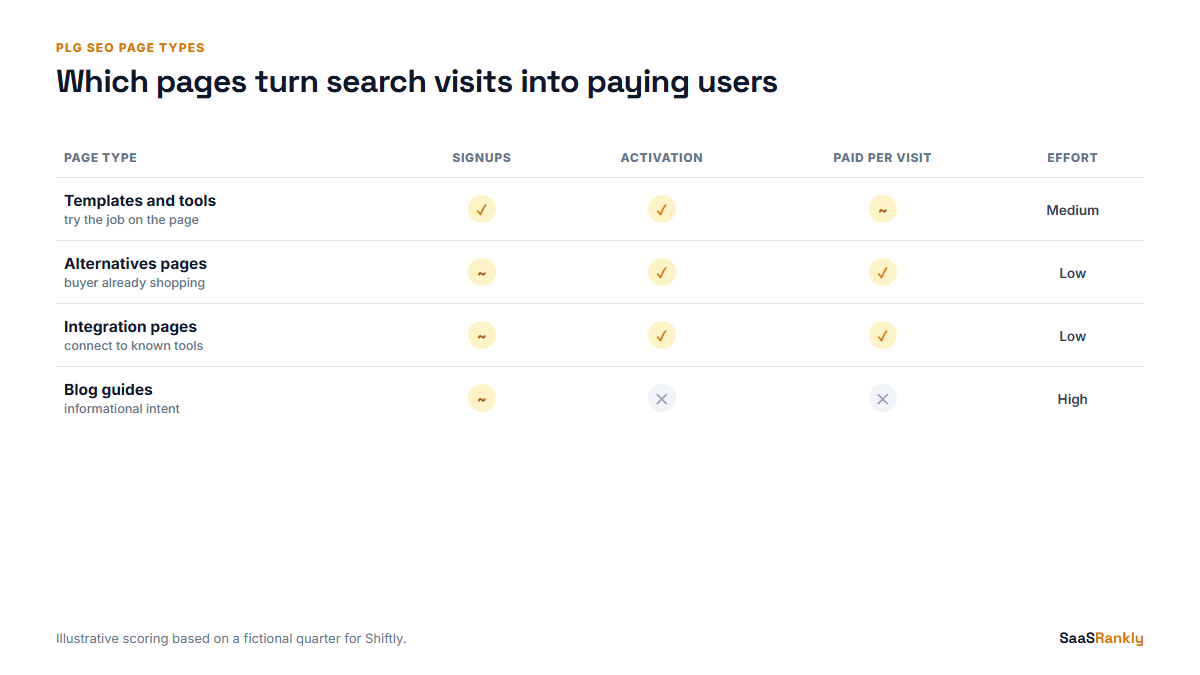
Here is an illustrative quarter for a fictional scheduling tool, Shiftly, priced at $12 per seat per month with a free plan for up to five seats. The numbers are invented but in the range we see on self-serve SaaS accounts.
| Page type | Pages shipped | Organic visits / month | Signups | Activated (week 1) | Paid after 60 days |
|---|---|---|---|---|---|
| Shift schedule templates | 12 | 9,400 | 610 | 340 | 41 |
| Competitor alternatives | 5 | 1,900 | 150 | 96 | 22 |
| Integration pages | 8 | 1,100 | 70 | 51 | 14 |
| Blog guides | 10 | 6,800 | 95 | 38 | 4 |
Two readings. Templates brought the most paying accounts in absolute terms, because each one put the product in front of a visitor in one click. Alternatives pages converted best per visit, at roughly 1.2 percent of visits becoming paid accounts versus 0.06 percent for blog guides. The blog was not useless; it fed internal links and a few backlinks. But if Shiftly had only one writer, the table says where the writer should spend the next quarter.
Metrics that matter for SEO in a PLG company
Product led growth gives SEO something sales-led companies rarely have: product data on every organic signup. Use it. These are the five numbers we put in the monthly report:
- Organic signups by landing page. Needs the first-touch landing page stored on the user record. Ask engineering for it in week one.
- Activation rate by landing page. The share of signups that hit your activation event within seven days. This is where weak-intent pages show themselves.
- Paid conversion within 60 or 90 days. Long enough for the free plan limit to bite.
- Expansion from organic accounts. Seats added after the first payment. PLG revenue grows here more than at first purchase.
- Visits per activated signup. The efficiency number to compare page types.
Our post on SaaS marketing channels by payback shows how to turn those numbers into a payback period you can put next to paid channels.
Common mistakes we see
- Signup walls on the content that ranks. Gating a template behind an account kills both the ranking and the signup. Let people see it, then ask them to sign up to use it.
- Blog-first content plans. The blog is the easiest thing to staff and the weakest PLG page type. Ship templates, alternatives and integrations first.
- Matching keywords to the wrong page. “Shift schedule template” wants a usable template, not an article about scheduling. Check intent before you brief; our keyword intent classifier is free for this.
- No owner for public user pages. Programmatic pages from user content need noindex rules for thin ones. We have seen sites lose half their crawl budget to empty public profiles.
Quick recap: product led growth
- Product led growth means self-serve start, fast first value and usage-based upgrades.
- A free plan or a trial alone does not make a company PLG.
- SEO usually sits at the top of the PLG loop and often brings the most signups.
- Templates, tools, alternatives and integration pages beat blog posts for PLG.
- Report on activated signups and paid conversion by landing page, not traffic.
- Never gate the content that ranks; ask for the signup at the moment of use.
FAQ
What is product led growth in simple terms?
It is a way of growing a software company where people can sign up and use the product without talking to sales, and the product’s own value convinces them to pay or upgrade.
What is the difference between product led growth and sales led growth?
In sales led growth, a salesperson qualifies and closes the buyer, usually after a demo. In product led growth, the user tries the product first and sales, if it exists, steps in later for larger accounts.
Is a free trial the same as product led growth?
No. A free trial is one pricing tactic. If the trial needs a setup call or the user cannot reach value alone, the company is still sales led with a trial attached.
How does SEO help product led growth?
SEO brings people to the signup page at low cost, and it scales with content rather than ad spend. Template, tool, comparison and integration pages tend to produce the most activated users.
What metrics should a PLG company track for organic search?
Organic signups by landing page, activation rate, paid conversion within 60 or 90 days, expansion revenue from organic accounts, and visits per activated signup.
Which companies use product led growth?
Well-known examples include Slack, Zoom, Calendly, Canva, Notion, Figma and Dropbox. Many of them later added sales teams for enterprise accounts while keeping the self-serve entry point.