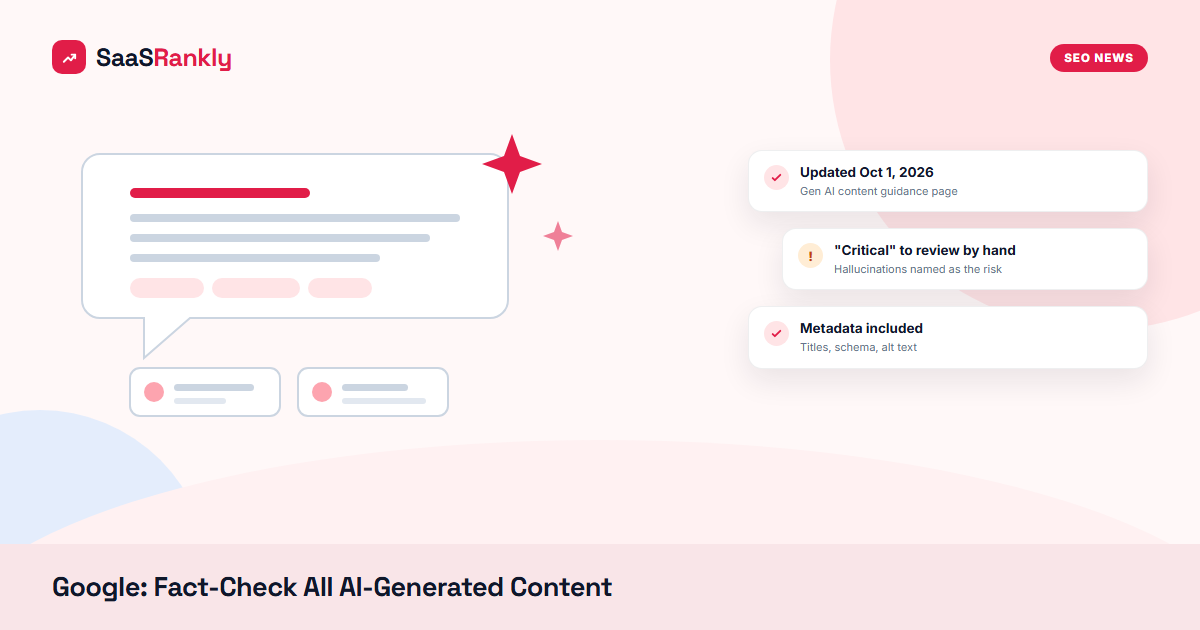
What happened: On October 1, 2026, Google updated its help page on using generative AI content in Search. The page now says, in plain words, “It is critical to manually factcheck and review all AI-generated content for accuracy and trustworthiness before publishing.” Google also widened the review step so it covers metadata: title tags, meta descriptions, structured data and image alt text. The page shows “Last updated 2026-10-01 UTC”, and the previous edit was in October 2025.
Source(s): Google Search Central: guidance on using generative AI content, reported by Search Engine Roundtable and Search Engine Journal.
What Google changed on the AI-generated content page
The edit is short, three sentences, but the wording is sharper than anything Google had on that page before. Google explains why it wants a human in the loop: generative models “don’t retrieve facts, but predict a likely sequence of words based on their training data,” so the output “may contain inaccuracies (also known as hallucinations).” Then comes the line with “critical” in it. Google rarely uses that word in Search documentation, which is why people noticed.
The second change is about metadata. The old text said the guidance “includes metadata.” The new text says the review “also applies to metadata.” Small swap, clear meaning: if a tool wrote your title tag, your meta description, your FAQ schema or your alt text, a person should read and check it too.
| Area | Before | After (Oct 1, 2026) |
|---|---|---|
| Fact-checking | General advice on accuracy and quality | “Critical” to manually factcheck and review all AI-generated content before publishing |
| Why | Not spelled out | Models predict words, they don’t retrieve facts, so hallucinations happen |
| Metadata | “This includes metadata” | “This review also applies to metadata”: titles, meta descriptions, structured data, alt text |
| Scaled content abuse | Mass pages without added value may break spam policy | Unchanged |
Google said the update brings the help page in line with what its team has been presenting at events. Gary Illyes has been saying for over a year that AI content should be “human curated,” and the Search Quality Rater Guidelines already deal with scaled and low-effort content. So this is not a new policy as much as Google writing its expectation down where every SEO will quote it.
Why this matters for SaaS sites using AI-generated content
Most SaaS content teams I talk to now use AI somewhere in the pipeline: first drafts, comparison tables, programmatic landing pages, bulk meta descriptions, alt text for screenshots. That is fine by Google’s rules. What the update targets is the “generate and ship” habit, where nobody checks whether the pricing in a comparison table is current or whether the integration a page promises actually exists.
Timing matters too. The September 2026 spam update started on September 24 and a second wave hit on September 30, according to Barry Schwartz. Google has not linked the doc change to that update, and I would not claim it did. Still, a spam update rolling out the same week Google tells sites to fact-check AI-generated content is a strong hint about where the reviewers’ attention is.
SaaS pages carry a special risk here. A hallucinated feature, a wrong price or a made-up stat on a “vs” page doesn’t just hurt rankings. It creates support tickets and churn when a buyer signs up expecting something that isn’t there. If you run programmatic SEO for SaaS, the same error can repeat across hundreds of URLs at once.
What to do this week
- Add a named reviewer step. Every page with AI-generated content gets a human owner who checks facts, numbers, prices and claims against a source before it goes live. Put the reviewer’s name in your content tracker, not just “QA done”.
- Audit AI-written metadata. Export titles, meta descriptions and alt text from your crawler and spot-check the ones a tool wrote. Look for claims (“free forever”, “#1 rated”) the page itself does not support.
- Validate structured data by hand on templates. If AI filled your FAQ or Product schema, run a sample through the schema validator and read the actual answers. Valid markup can still say something false.
- Prune or merge thin AI pages. Programmatic pages that add nothing beyond a swapped keyword are exactly what the scaled content abuse policy describes. Merge them or add real data before the next spam wave does it for you.
If you are picking tools for the drafting side, our list of the best AI SEO tools notes which ones make source-checking easy and which ones invent citations.
Quick recap: AI-generated content and Google’s new wording
- Google updated its AI-generated content guidance on October 1, 2026.
- The page now says it is “critical” to manually factcheck AI-generated content before publishing.
- Review of AI-generated content now clearly covers titles, meta descriptions, structured data and alt text.
- Using AI is still allowed; publishing unchecked AI-generated content at scale is the risk.
- The change lands during the September 2026 spam update rollout, so audit AI-generated content pages now.
- For SaaS sites, wrong prices and invented features in AI-generated content cost both rankings and customers.