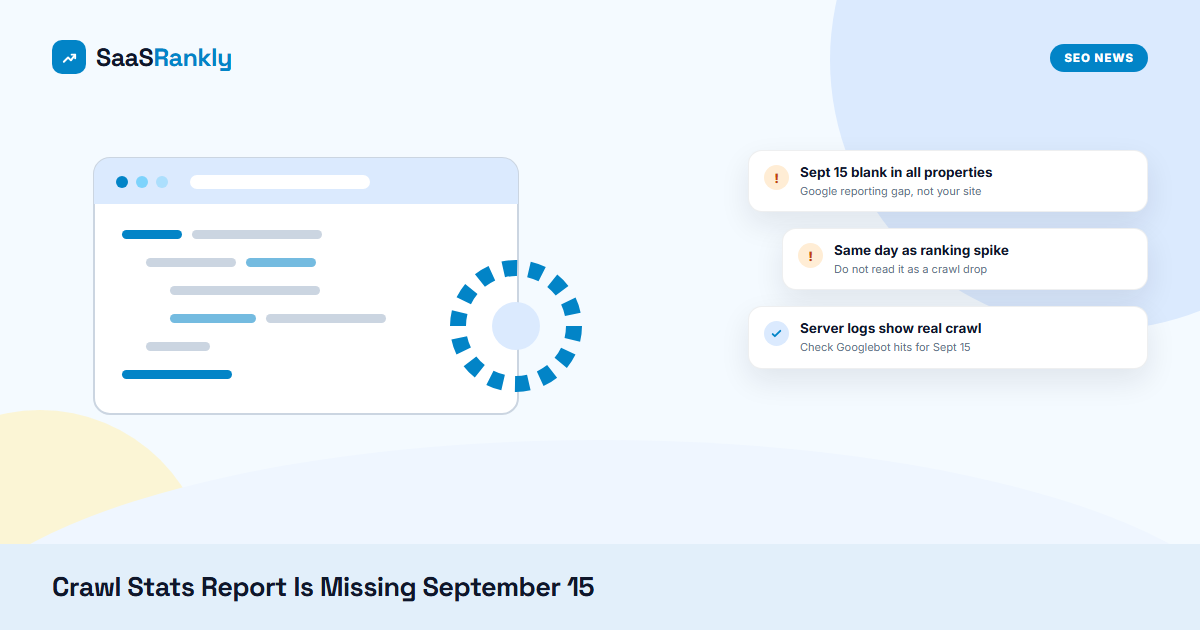
What happened: Google Search Console’s Crawl Stats report is missing a full day of data for September 15, 2026. The gap shows up in every property, not just a few, and was flagged by Alif Shorif and reported by Search Engine Roundtable on September 20 with a simple note: “This is not an issue with your site.” Google has not commented yet. The report has had the same kind of hole before, most recently in August 2026 and October 2025, and Google has usually restored the data afterwards.
Source(s): Search Engine Roundtable report and Google’s own Crawl Stats report help page.
Why a missing Crawl Stats day matters this week
On a normal week, one blank day in a crawl chart is a shrug. This is not a normal week. September 15 is the same day ranking trackers picked up a fresh volatility spike, which we wrote about in the unconfirmed September update post. It also sits right in the window when Google got better at blocking scrapers and rank tools.
So plenty of SaaS teams are going to open Search Console this week to work out what happened on the 15th. If they open the crawl report, they will see total crawl requests drop to zero or near zero for that day and bounce back on the 16th. That looks exactly like Googlebot backing away from a site after a quality reassessment. It is not. It is a reporting gap.
The risk is a bad call made off a fake signal: rolling back a release, blaming a CDN change, or opening a ticket with your host over a crawl collapse that never happened.
What the gap does and does not affect
| Area | Affected? | Notes |
|---|---|---|
| Crawl Stats totals and charts | Yes | September 15 is blank or near zero in every property |
| Breakdowns (response, file type, purpose, Googlebot type) | Yes | Same missing day across every breakdown |
| Actual Googlebot crawling | No evidence | Your server logs show the real picture |
| Performance report | Not reported | No gap reported so far |
| Page indexing report | Not reported | Separate pipeline from the crawl report |
One thing worth knowing: the report has no API and only keeps about 90 days of history. If Google never back-fills the day, nothing downstream can recover it. We saw the same pattern when the indexing report lost its June data and Google said it would not fill the hole.
What to do about the Crawl Stats gap
- Annotate September 15 in whatever dashboard you use. Mark it as “Crawl Stats reporting gap, Google side” so nobody on the team reads it as a crawl drop in three weeks’ time.
- Check your server logs for the real crawl count. Filter for verified Googlebot requests on September 15 and compare to the days on either side. If the count looks normal, you have your answer. Our technical SEO for SaaS guide covers log checks in more detail.
- Leave the 15th out of week-over-week crawl comparisons. A blank day drags the weekly average down by roughly 14%, which is enough to trigger alerts on its own.
- Export the report monthly. With a 90-day window and no API, a screenshot or CSV each month is the only way to keep a longer record. While you are in there, run the sitemap checker to make sure the pages you want crawled are the ones you are feeding Google.
Also from the weekend
Web Guide, Google’s opt-in beta that mixes AI summaries with regular results, has a bug where the “Classic search” button just reloads Web Guide. Damien Andell spotted it and Glenn Gabe saw it happen on and off. It only touches people enrolled in the beta, so it will not show up in your traffic, but it is another small sign that Google’s AI layers are getting harder to step out of.
Quick recap: Crawl Stats
- The Crawl Stats report in Search Console is missing September 15, 2026 for every property.
- The Crawl Stats gap is a Google reporting problem, not a drop in Googlebot activity on your site.
- Google has usually restored missing Crawl Stats data after past gaps.
- September 15 overlaps an unconfirmed ranking spike, so do not read the blank day as a quality signal.
- Server logs are the backup source when Search Console data goes missing.
- Export Crawl Stats monthly, because the report keeps only about 90 days and has no API.